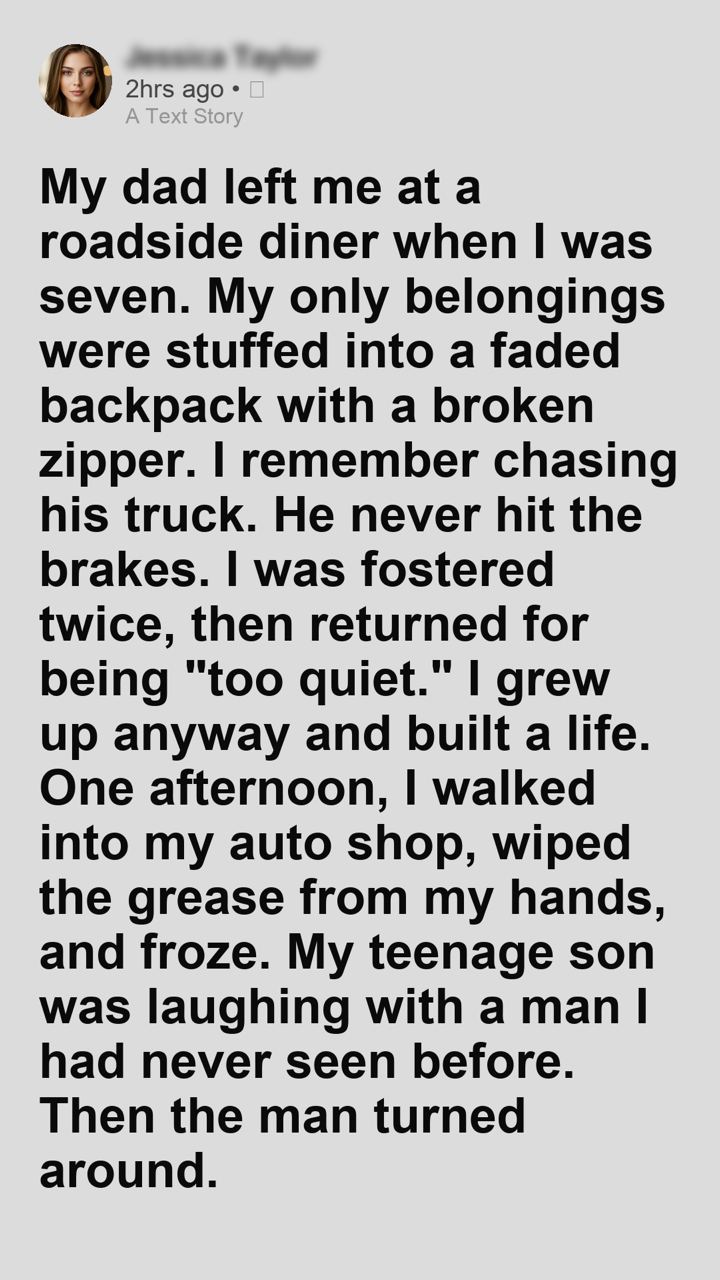
I was seven years old when my father left me at a dusty roadside diner. My memories from that day are sharp in strange, painful ways. I remember the smell of stale coffee and diesel fuel. I remember the cracked red vinyl of the booth, sticky against the back of my legs. And I remember my faded blue backpack—the one with the broken zipper—stuffed with a few changes of clothes.
“Wait here while I pay the tab,” he had said.
I remember watching through the greasy window as he walked right past the register, got into his truck, and pulled out. I ran outside, chasing the taillights down the highway. I yelled for him. He never hit the brakes.
I stayed on that curb until a waitress with sad eyes brought me inside and called the police. I watched the door for hours, convinced he would come rushing back, claiming he forgot me.
He never did.
I was fostered twice. Families who wanted a grateful, bubbly child and got a withdrawn, silent one instead. After a few months, I was always sent back. My caseworkers used the phrase “failure to attach.” Those words haunted me for a long time.
But I did grow up. I learned how to keep my head down and my walls high. I learned a trade, worked grueling hours, and eventually opened my own small auto repair shop. I built a life that looked solid—a business, a modest house, a routine that kept me grounded.
I told myself I didn’t care about the past. I didn’t have time for it. I became a father myself. And when I held my son for the first time, I made him a silent, unbreakable promise: I will never leave you behind.
Years passed. Life was exhausting, loud, and full of grease and hard work.
Then one afternoon, everything shifted. I came out of the service bay, wiping my hands on a shop towel, my mind already on the next repair. I walked into the front office and froze.
My teenage son was leaning over the counter, laughing with a man I had never seen before. It was the kind of easy, warm laughter that you usually only share with family. Every protective instinct I had flared up.
“Can I help you?” I asked, my voice harder than I intended.
The man stopped laughing. Slowly, he turned around.
I recognized him instantly, despite the lines on his face and the gray in his hair. Marcus. My older brother.
When our dad abandoned me, he kept Marcus. Marcus was twelve—old enough to swing a hammer, old enough to be useful. Our father had plans for him to be his free labor, a built-in deckhand for his sketchy contracting business. I always assumed Marcus lived a decent life. The useful one. The one worth keeping.
I was wrong. Marcus ran away at fifteen to escape the physical abuse and endless labor. He survived on construction sites, sleeping in trucks, fighting for every dollar.
He saw our father only once after that—to identify his body at the county morgue years later. He never reached out to me. Not because he didn’t care.
Because he did. He told me later, sitting in my office with tears in his eyes, that the guilt had consumed him. Guilt that he hadn’t jumped out of the truck that day at the diner. Guilt that I was thrown away while he was forced to stay. He felt he hadn’t earned the right to look me in the eye until he could make it right.
Years ago, when I was trying to open my shop, I was rejected for every bank loan. Then, a massive anonymous check arrived from an “angel investor” firm, covering the lease and the first round of equipment. I thought it was a miracle.
It wasn’t. It was Marcus. He had been quietly watching out for me for years—working himself to the bone to make sure I had the foundation he never did, asking for zero credit.
He showed up today because his car had genuinely broken down on the interstate, and the tow truck brought him to the nearest highly-rated shop. Mine. When he walked in and saw my son—who looks exactly like I did at that age—he knew immediately.
“He has your laugh,” Marcus said, his voice breaking.
I crossed the room, grabbed my brother, and hugged him for the first time in twenty-five years. I cried into his shoulder. The kind of crying that washes away decades of quiet, lonely survival.
Later that week, we drove out to where our father was buried. I stood there, staring at the neglected headstone of the man who had left me in the dust. I waited for the anger. For the bitterness. For the familiar, hollow ache.
It didn’t come.
For the first time in my life, I felt completely whole. Because I wasn’t alone. And my brother’s quiet, fierce protection—unseen but always there—gave me the family my father had tried to throw away.