For twelve years, I was convinced my older brother, David, was the most selfish man alive.
He was the golden child. The one who went to the Ivy League school. The one who landed the six-figure job straight out of college. The one who drove a luxury car while I was barely scraping by, working two jobs just to keep the lights on in my cramped apartment.
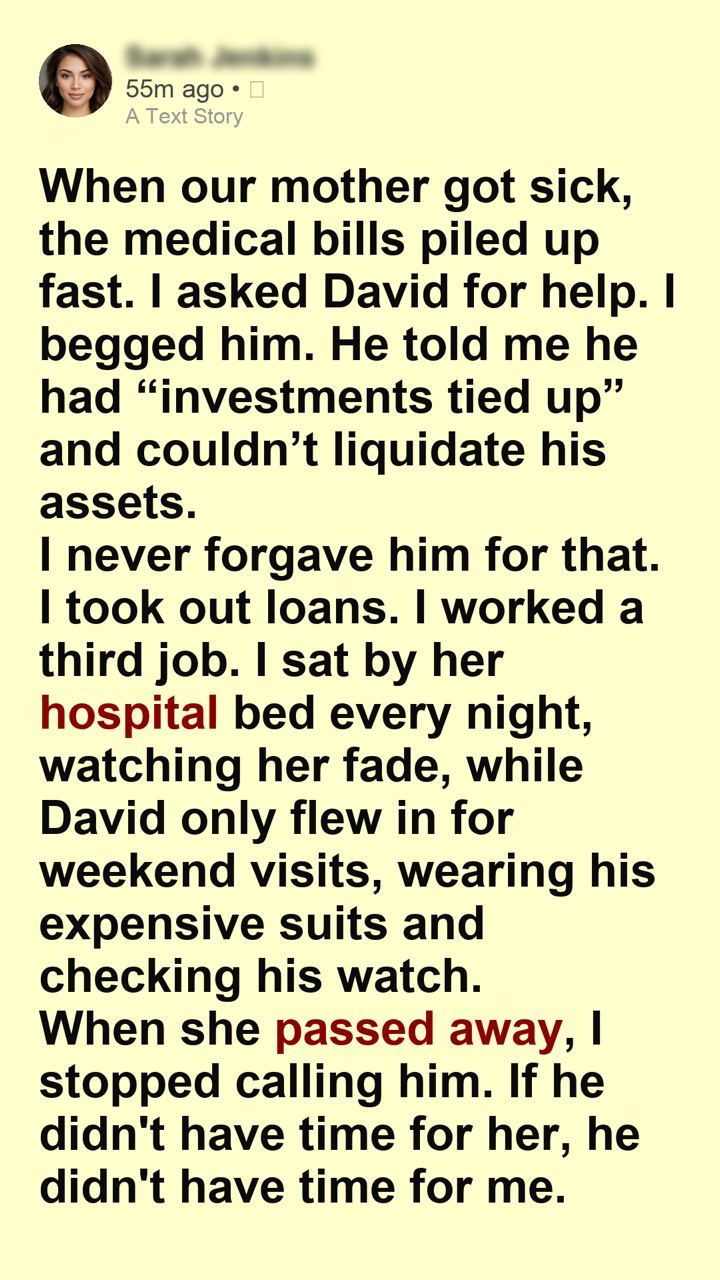
When our mother got sick, the medical bills piled up fast. I asked David for help. I begged him. He told me he had “investments tied up” and couldn’t liquidate his assets.
I never forgave him for that. I took out loans. I worked a third job. I sat by her hospital bed every night, watching her fade, while David only flew in for weekend visits, wearing his expensive suits and checking his watch.
When she passed away, I stopped calling him. If he didn’t have time for her, he didn’t have time for me.
Years turned into a decade. I eventually clawed my way out of debt. I opened a small bakery—a dream my mother and I used to talk about. It wasn’t a glamorous life, but it was mine, and I was proud I built it without a single dime from my millionaire brother.
Then, last Tuesday, a man in a gray suit walked into my shop. He wasn’t a customer. He was a lawyer.
“I’m looking for Maya,” he said, opening a leather briefcase.
“That’s me,” I replied, wiping flour off my apron.
He looked at me with a soft, almost pitying expression. “I am the executor of your brother David’s estate. I’m terribly sorry to inform you… David passed away from an aneurysm three days ago.”
The flour brush dropped from my hand. I didn’t cry. I just felt hollow. A weird, empty numbness. My brother was gone, and my first thought was a bitter: I wonder who gets the sports car.
“He left everything to you,” the lawyer continued, placing a thick manila envelope on the counter. “But he gave me strict instructions to give you this file first.”
My hands felt numb as I opened the envelope. Inside wasn’t a will. It was a stack of hospital receipts from twelve years ago. My mother’s hospital receipts.
I frowned, flipping through them. The “balance due” on every single one of the massive, crushing bills was marked PAID IN FULL. And next to the stamp, in small print, was the payer’s name: David Miller.
My heart skipped a beat. “I don’t understand,” I whispered. “I paid these. I took out loans.”
“Look at the dates, Maya,” the lawyer said gently.
I looked closer. The bills were paid months before I ever went to the bank.
Then I found the loan documents in the back of the envelope. The private, anonymous lender who had approved my massive, high-risk loan when every major bank laughed in my face? It was an LLC. An LLC owned entirely by David.
He didn’t refuse to help. He paid for everything. And when he saw my pride hurting, when he saw me desperate to feel like I was taking care of our mother, he funded the very loan I used to “pay” for it—and then quietly forgave the interest.
At the bottom of the stack was a handwritten note on his company letterhead.
Maya, I know you hate me. I know you think I abandoned you both. But Mom asked me not to tell you how bad her diagnosis was because she knew you would drop out of culinary school. I couldn’t save her. But I could save you. You are so fiercely independent, so proud. If I handed you cash, you would have felt like a failure. You needed to build your own life. You needed to be the hero. I took the anger so you could keep your pride. I’ve watched your bakery from across the street every opening day. The bread is incredible, kid. Keep baking. Love, David.
I collapsed into the chair behind the counter. The bakery around me—the walls, the ovens, the life I thought I built completely on my own—suddenly looked entirely different. It wasn’t built on my defiance. It was built on my brother’s silent, thankless love.
I sat there and wept until my lungs burned. For twelve years, I thought I was carrying the weight of the world alone. I never realized my brother had been holding up the floor beneath my feet the entire time.