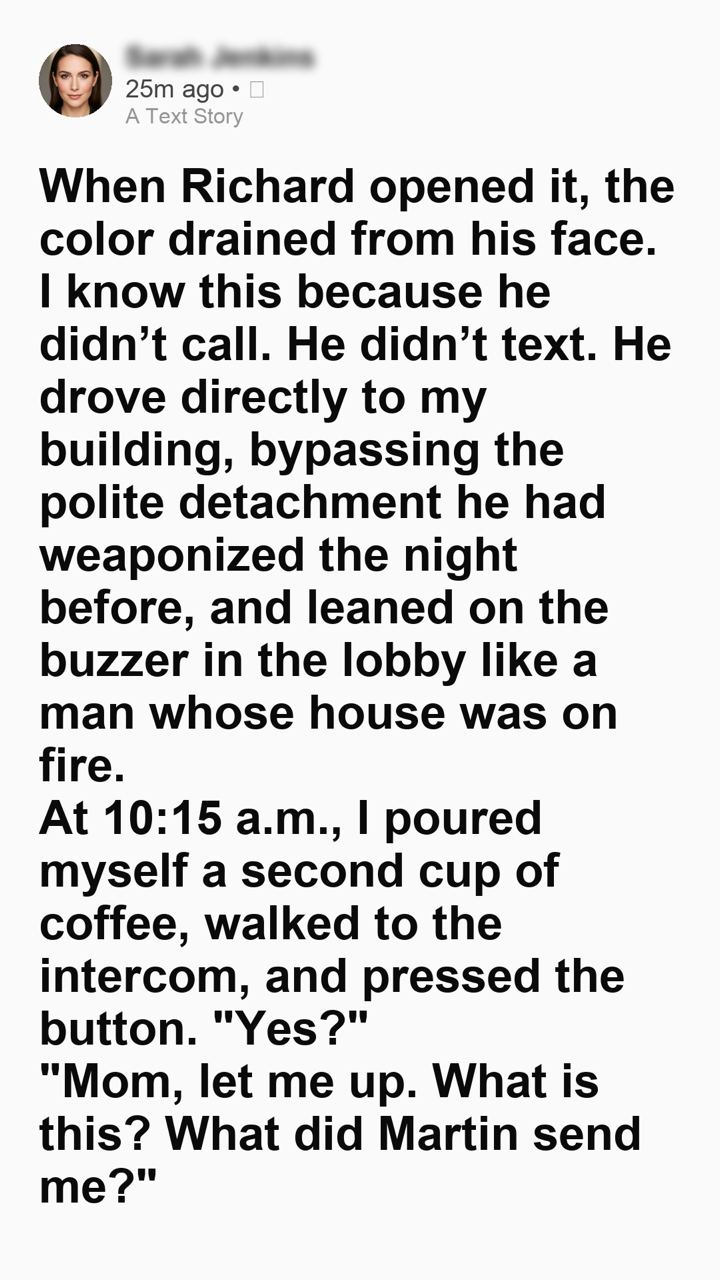
When Richard opened it, the color drained from his face.
I know this because he didn’t call. He didn’t text. He drove directly to my building, bypassing the polite detachment he had weaponized the night before, and leaned on the buzzer in the lobby like a man whose house was on fire.
At 10:15 a.m., I poured myself a second cup of coffee, walked to the intercom, and pressed the button. “Yes?”
“Mom, let me up. What is this? What did Martin send me?” Richard’s voice was entirely stripped of the polished, country-club veneer he had worn at the podium. He sounded breathless. Panicked.
“It’s exactly what it looks like, Richard,” I said, my voice as calm and level as it had been under the floral arch. “It is an invoice, and a notice.”
“Mom, please, let me up so we can talk. Susan is in the car. She’s hyperventilating. You can’t do this.”
The envelope Martin Hayes had sent via courier contained three very specific pieces of paper.
The first was a formal demand letter for $168,500. Because my name was on every single contract, I was legally the host of the event. By deliberately barring the legal host and financier from the venue, Richard and Susan had committed what Martin expertly classified as “unauthorized appropriation of a private event.” He had given them thirty days to reimburse my estate in full.
The second document was a formal notification that Richard had been removed as the primary beneficiary and executor of my will, and entirely severed from his father’s family trust.
But it was the third piece of paper that had undoubtedly sent them speeding across town.
It was a sixty-day notice to vacate. The stunning, five-bedroom colonial home where Richard and Susan hosted their lavish neighborhood wine tastings? It didn’t actually belong to them. It belonged to a property holding LLC that my late husband, Robert, and I had created thirty years ago. I was the sole managing member. I had allowed them to live there rent-free for twelve years as an act of maternal grace.
“There’s nothing to talk about, Richard,” I said into the intercom, taking a slow sip of my coffee.
“Mom, it was a misunderstanding!” he pleaded, the desperation cracking his voice. “The wedding planner messed up the master guest list! Susan panicked. We didn’t know how to handle it in the moment without causing a scene!”
“Susan didn’t look panicked,” I corrected gently. “And you didn’t look for a solution. You didn’t pull me aside. You didn’t ask the planner to add a chair. You looked at me, your mother, and you humiliated me in public because you thought my money was already spent and my usefulness had expired.”
“Clara is devastated!” he tried, playing his final card. “She was crying all night! She didn’t know!”
I paused. That was the one variable that still hurt. “If Clara truly didn’t know,” I said softly, “she has my phone number. She can call me herself. But you and Susan? You are no longer my concern.”
“Mom, we don’t have $168,000! We don’t have anywhere to go if you sell the house!”
“You should have thought of that before you decided I wasn’t on the list,” I said. “Please direct all further communication to Martin Hayes. Do not come to my building again.”
I took my finger off the button. The intercom clicked off, leaving my apartment in absolute, pristine silence.
Clara did call me, later that afternoon. She was crying. Richard and Susan had told her I had suffered a severe migraine and had to go home before the ceremony started. When I told my granddaughter the truth—and sent her the text messages to prove it—her heartbreak was genuine. We had a long, tearful conversation. I told her I loved her, that her wedding was beautiful, and that my relationship with her would remain intact, but my relationship with her parents was permanently over.
Six months later, the colonial house was sold. Richard and Susan were forced to downsize to a modest apartment on the other side of the city, their social standing thoroughly dismantled by the quiet, undeniable reality of their new financial bracket.
As for me, I took the $168,500 they eventually had to borrow against their own retirement to pay back, and I booked a first-class ticket to Paris.
I packed my mother’s pearls, my favorite French perfume, and the quiet, unshakeable peace of a woman who finally knew exactly what she was worth.