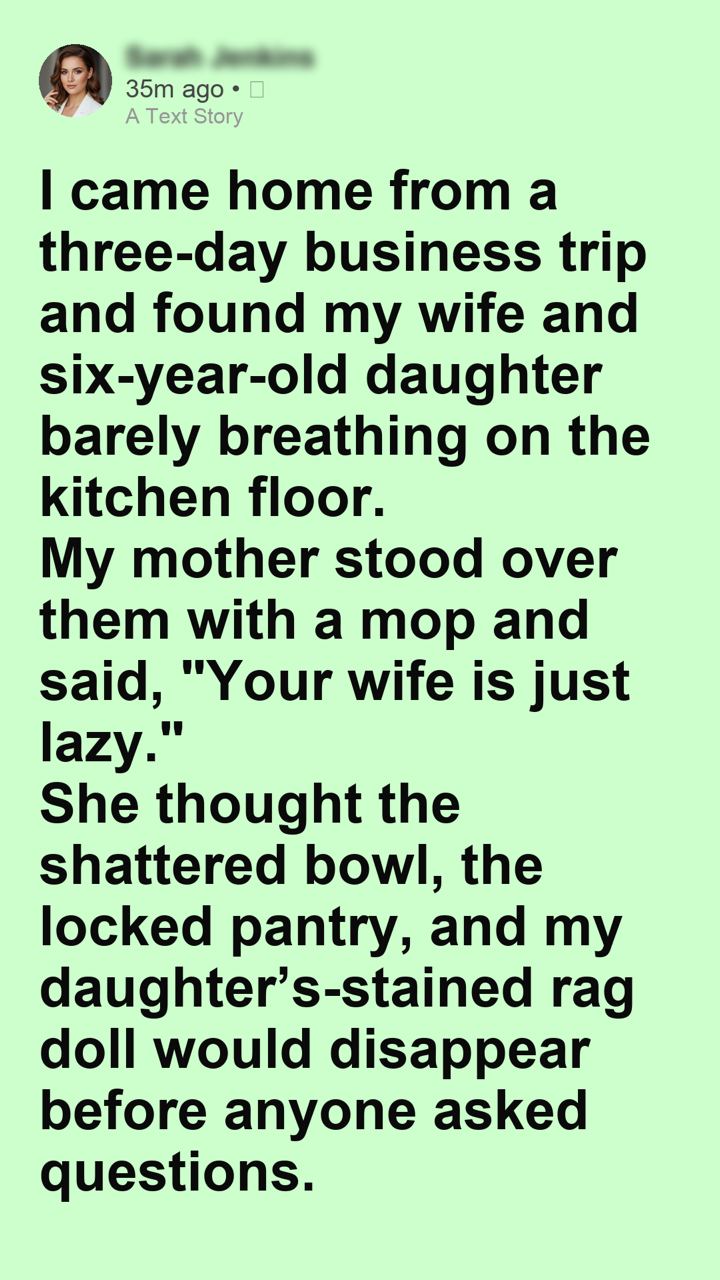
I came home from a three-day business trip expecting to hear my daughter’s feet pounding down the hallway.
Instead, the house was silent.
Too silent.
I dropped my suitcase beside the front door.
“Emma?”
Nothing.
“Sarah?”
Still nothing.
Then I heard a faint sound from the kitchen.
A soft, irregular gasp.
My heart stopped.
I ran toward it.
My wife was lying on the kitchen floor.
Beside her was our six-year-old daughter, Emma.
Both were barely moving.
Emma’s face was pale.
Her small hands were curled around her favorite rag doll.
“Sarah!”
I dropped to my knees.
“Emma!”
No response.
Then I saw my mother standing over them.
She was holding a mop.
Calmly.
Almost casually.
She looked at me and sighed.
“Your wife is just lazy.”
For a second, I couldn’t understand what I was hearing.
“What?”
“She probably hasn’t eaten properly again.”
My mother pointed toward the counter.
“There was a mess. Your wife collapsed. The child followed.”
I stared at her.
Then at my wife.
Then at my daughter.
“Call 911.”
My mother didn’t move.
“She’s exaggerating.”
I pulled out my phone myself.
“I said call 911!”
I called emergency services.
My hands were shaking so badly I almost dropped the phone.
While I waited, I checked my daughter’s breathing.
Weak.
My wife’s breathing was even worse.
I looked around the kitchen.
A ceramic bowl lay shattered across the floor.
The pantry door was locked.
There was a strange chemical smell in the air.
And Emma’s rag doll was stained dark around one arm.
Something was very wrong.
The paramedics arrived within minutes.
They rushed both of them out.
My mother followed me toward the ambulance.
“Don’t make this into something it isn’t.”
I turned around.
“What happened here?”
“I told you.”
“Why was the pantry locked?”
She hesitated.
“Your wife locks everything.”
“No, she doesn’t.”
“Maybe she did.”
“Why is Emma’s doll covered in that stain?”
My mother looked at the doll.
For the first time, her face changed.
“It’s just dirt.”
I stared at her.
“Then why are you afraid of it?”
She said nothing.
The ambulance doors closed.
I climbed into my car and followed them to the hospital.
My mother came too.
For the next hour, doctors worked on my wife and daughter.
I sat outside the emergency room with my hands clasped together.
I couldn’t stop replaying the scene.
My mother standing there.
The mop.
The locked pantry.
The broken bowl.
The doll.
Finally, a doctor came out.
“Are you Mr. Carter?”
“Yes.”
“Your wife and daughter are stable.”
My knees nearly gave out.
“But they’re not out of danger yet.”
“What happened?”
The doctor hesitated.
“We believe they were exposed to something toxic.”
My blood ran cold.
“Toxic?”
“Yes.”
“Food?”
“We’re investigating.”
My mother immediately stepped forward.
“They must have eaten something spoiled.”
The doctor looked at her.
“Are you the grandmother?”
“Yes.”
“Were you present when they became ill?”
My mother nodded.
“I found them on the floor.”
I stared at her.
“You didn’t find them.”
She looked at me.
“You were standing over them.”
She frowned.
“I was cleaning.”
The doctor excused himself.
I looked at my mother.
“Where were you when this happened?”
“At home.”
“Why?”
“Because you asked me to check on them while you were gone.”
“I asked you to visit.”
“You’re splitting hairs.”
“No.”
I lowered my voice.
“I’m trying to understand why my wife and daughter almost died while you were here.”
My mother crossed her arms.
“Your wife has always been dramatic.”
I said nothing.
That was the last time I believed anything she said.
The next morning, detectives came to the hospital.
They asked about my mother’s involvement.
I told them everything.
They asked about the house.
The pantry.
The food.
The broken bowl.
The doll.
When I mentioned the doll, one detective immediately asked:
“Where is it?”
I told him my daughter had been holding it when the paramedics arrived.
He exchanged a look with his partner.
“Don’t throw it away.”
“I wasn’t planning to.”
“Good.”
They took it for testing.
My mother became furious.
“This is ridiculous.”
The detective looked at her.
“Why?”
“Because it’s a child’s toy.”
“Sometimes children’s toys tell us a lot.”
My mother stopped talking.
Three days later, the detective called me.
“Can you come down to the station?”
I went immediately.
He placed a clear evidence bag on the table.
Inside was Emma’s rag doll.
The stained arm had been cut open.
Something small had been removed from inside.
“What is that?”
The detective looked at me.
“A medication pouch.”
My stomach dropped.
“What?”
“It had been hidden inside the doll.”
I stared at him.
“There was a prescription medication inside the doll. Not one intended for either your wife or daughter.”
“Whose was it?”
“We’re still testing it.”
I thought about the locked pantry.
The shattered bowl.
My mother standing over them.
Then the detective said:
“There’s more.”
He slid another photo across the table.
It showed the inside of the doll.
There was a small plastic packet taped beneath the stuffing.
And beside it was a handwritten note.
My handwriting.
Except I had never written it.
The note said:
“Take these when he leaves. It will make them sleep.”
I couldn’t breathe.
“That’s not mine.”
“We know.”
“Who wrote it?”
“We’re checking.”
My mother had been sitting in the waiting area.
The detective asked her to come inside.
When she saw the photograph, she went completely still.
The detective asked:
“Do you recognize this handwriting?”
“No.”
“Are you sure?”
“Yes.”
I looked at her.
“Mom.”
She wouldn’t meet my eyes.
Then the detective placed another document on the table.
It was a pharmacy receipt.
The medication had been purchased two days before I left on my business trip.
The buyer’s name was my mother.
She finally broke.
“I didn’t mean to hurt them.”
My chair scraped backward.
“You poisoned my wife and daughter?”
“No!”
“You put something in my daughter’s doll!”
“I was trying to make your wife leave.”
I stared at her.
“What?”
She began crying.
“Your wife was destroying this family.”
I couldn’t believe what I was hearing.
“She was a bad mother.”
“She wasn’t.”
“She kept you away from us.”
“She didn’t.”
“She took you from me.”
I shook my head.
“No.”
My mother wiped her face.
“I thought if she became sick enough, you’d send her away.”
“And Emma?”
She looked down.
“I didn’t know she’d get sick too.”
I stood up.
“You locked the pantry.”
“I wanted them to think the food was contaminated.”
“You broke the bowl.”
“I needed it to look like an accident.”
“And the doll?”
My mother closed her eyes.
“I hid the medication inside it.”
“Why?”
“Because Emma carried it everywhere.”
I felt sick.
“You knew she would.”
She didn’t answer.
That silence told me everything.
My daughter wasn’t collateral damage.
My mother had known exactly what she was doing.
She had simply believed nobody would discover it.
The detective arrested her that afternoon.
My wife eventually woke up.
When I entered the hospital room, she looked at me.
“Where’s Emma?”
“She’s okay.”
She began crying.
“I was so scared.”
I took her hand.
“I know.”
“What happened?”
I looked toward the window.
“My mother.”
Her expression changed.
“What did she do?”
I told her everything.
She covered her mouth.
Then she whispered:
“Emma’s doll.”
I nodded.
“The doll saved us.”
She looked confused.
I explained that when detectives opened it, they found the medication packet and the note.
My wife closed her eyes.
Emma had been sleeping in the next room.
She woke later that evening.
Her first question was predictable.
“Daddy?”
“I’m here.”
“My dolly?”
I held it up.
“We found something inside.”
She frowned.
“What?”
I looked at my daughter.
“Something that shouldn’t have been there.”
She hugged me.
“Can I have her back?”
I smiled sadly.
“Not this one.”
She looked disappointed.
So I promised her something.
“We’ll make a new one.”
She smiled.
“Can it have a purple dress?”
“Absolutely.”
Months later, my wife and daughter were finally healthy again.
My mother was facing serious criminal charges.
Our house was quiet.
But it was peaceful.
One afternoon, Emma sat beside me at the kitchen table.
She was drawing.
“What are you drawing?”
She held up the picture.
It showed three people holding hands.
Me.
Her.
And her mother.
Above us was a giant yellow sun.
“What about Grandma?” I asked.
Emma looked at the paper.
Then she shook her head.
“She isn’t in our family picture anymore.”
My heart broke.
But I understood.
Children don’t always understand complicated betrayal.
They understand safety.
And she knew who had made her feel safe.
I kept the old rag doll in a box.
Not because I wanted to remember what happened.
But because it reminded me of something important.
The smallest things can carry the biggest truths.
My mother thought a shattered bowl would look like an accident.
She thought a locked pantry would go unnoticed.
She thought my wife would be blamed for being “lazy.”
She thought a child’s rag doll was just a toy.
She was wrong.
That little stained doll contained the evidence that saved my family.
And whenever I think about that terrifying day, I remember the lesson it taught me:
Never dismiss the details that don’t make sense.
Sometimes the broken bowl isn’t an accident.
Sometimes the locked door isn’t protection.
And sometimes the quietest object in the room is the one carrying the truth.