My family had always been good at making me feel small.
At Sunday dinners, my father would ask about my career with the same expression people use when they’re trying not to laugh.
“So,” he would say, “still playing soldier?”
My brother would chuckle.
My sister would roll her eyes.
And my mother would quietly change the subject.
I had learned not to react.
But that evening was different.
I had come home because my mother had asked me to attend a family dinner.
She said it was important.
I should have known.
The moment I walked through the front door, I saw my brother’s friends sitting in the living room.
My uncle was there too.
Everyone seemed to be waiting for something.
My father stood beside the fireplace.
“We need to talk about your choices.”
I took off my coat.
“My choices?”
“You’ve embarrassed this family long enough.”
I looked at him.
“Because I’m in the military?”
“Because you’re wasting your life.”
My brother laughed.
“You’re nearly forty and still taking orders.”
I didn’t answer.
My father continued.
“Your cousin is a surgeon. Your brother owns a company. Your sister has a master’s degree.”
He pointed at me.
“And you?”
“I serve.”
He laughed.
“You polish boots.”
My mother looked down.
I felt something inside me finally go quiet.
I’d spent years trying to earn their approval.
Years of deployments.
Years away from home.
Years of waking up before sunrise.
Years of doing work I couldn’t talk about.
But to them, it was never enough.
My brother leaned back.
“So what’s your rank now?”
I looked at him.
“Colonel.”
The room went silent for half a second.
Then he laughed.
“Colonel?”
My father smirked.
“Don’t exaggerate.”
“I’m not.”
My sister laughed.
“That’s impressive.”
Her tone made it clear she didn’t mean it.
Then my father said something I would never forget.
“You know what your problem is?”
I waited.
“You think wearing a uniform makes you important.”
I looked at him.
“No.”
“Then what does?”
“Doing the job.”
My brother shook his head.
“You’ve always been the family embarrassment.”
That sentence hurt.
Not because it was new.
Because I realized I finally believed him.
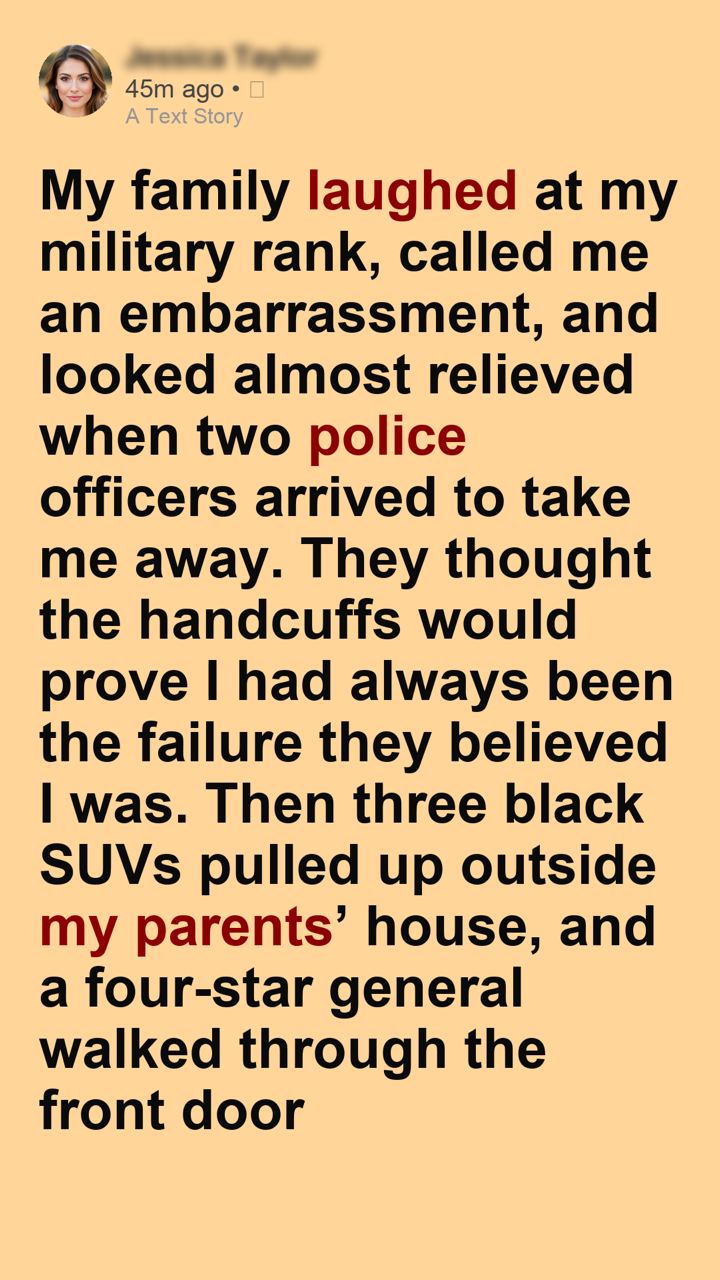
Then two police officers knocked on the door.
Everyone went quiet.
My mother looked at me.
My father smiled.
The older officer stepped inside.
“Are you Daniel Carter?”
“Yes.”
“Sir, we need you to come with us.”
My brother immediately stood up.
“What did he do?”
The officer didn’t answer.
He simply produced a pair of handcuffs.
My mother’s face changed.
My father whispered:
“I knew it.”
I looked around the room.
Nobody looked surprised.
They looked relieved.
As if the handcuffs had finally proven everything they’d believed about me.
My sister covered her mouth.
My brother whispered:
“Unbelievable.”
I looked at the officer.
“Do you have a warrant?”
“Yes.”
He handed me a copy.
I read it.
My name was there.
So was a list of allegations.
My stomach tightened.
Fraud.
Misuse of classified information.
Unauthorized disclosure.
My family started whispering.
My father looked almost proud.
“I told you.”
The officer put the cuffs on.
I didn’t resist.
I didn’t explain.
Because I knew something they didn’t.
The allegations weren’t about my military service.
They were connected to a classified investigation that had been ongoing for months.
And there was nothing I could say in that living room.
So I let them take me outside.
My family followed.
My brother was already texting people.
My sister was crying.
My father kept saying:
“This is what happens when you live outside the law.”
Then the first black SUV arrived.
Everyone stopped.
A second SUV pulled in.
Then a third.
Three vehicles.
No markings.
Men and women in formal military uniforms stepped out.
My father frowned.
“What is this?”
Nobody answered.
The doors of the middle SUV opened.
A four-star general stepped out.
My brother’s phone dropped from his hand.
The general walked directly toward the house.
The police officers immediately stepped aside.
My father looked confused.
The general entered.
He looked around the room.
Then his eyes landed on me.
“Colonel Carter.”
I nodded.
“General.”
He turned toward my family.
“Who is responsible for this?”
Nobody spoke.
My mother looked terrified.
My father finally asked:
“Who are you?”
The general looked at him.
“General James Whitmore.”
My father’s face went white.
The general turned back to me.
“I’m sorry this happened in front of your family.”
Then he looked at the officers.
“Remove the restraints.”
My brother stared.
“What?”
The general didn’t acknowledge him.
The cuffs came off.
My father stepped forward.
“But he’s under arrest.”
“No.”
The general looked at him.
“He isn’t.”
My sister whispered:
“Then why did the police—”
“Because this was part of an operation.”
Silence.
My family looked at me.
The general continued.
“Colonel Carter has spent the last eighteen months working undercover with federal investigators.”
My mother covered her mouth.
My brother stared.
My father couldn’t speak.
The general looked around the room.
“The allegations were fabricated.”
My father finally found his voice.
“Then why arrest him?”
“To identify who would react.”
The room went completely silent.
The general handed me a folder.
“We have identified the leak.”
I opened it.
Inside were names.
Dates.
Bank records.
Messages.
One name appeared repeatedly.
My brother’s.
I looked at him.
He stepped backward.
“No.”
I said nothing.
The general continued.
“Your brother has been transferring confidential information through a third party connected to an international criminal network.”
My brother’s face drained of color.
“That’s impossible.”
The general looked at him.
“We have financial records.”
My father turned toward my brother.
“What is he talking about?”
My brother shook his head.
“You can’t believe him.”
The general looked at me.
“Colonel, would you like to explain?”
I closed the folder.
“No.”
My father stared at me.
“Why didn’t you tell us?”
I looked at him.
“Because I couldn’t.”
“But we thought—”
“I know.”
My mother’s eyes filled with tears.
“We thought you were failing.”
I nodded.
“You did.”
She looked devastated.
“I thought you were wasting your life.”
“I know.”
My brother suddenly shouted.
“This is a setup!”
The general turned toward him.
“You’re entitled to counsel.”
My brother froze.
Two federal agents stepped forward.
They placed handcuffs on him.
My father stared in horror.
“Wait.”
The general looked at him.
“You may want to speak with your attorney as well.”
My father looked confused.
“Why?”
The general opened another folder.
“Because some of the financial transfers originated from accounts belonging to you.”
My father’s face collapsed.
I stared at him.
He looked at me.
“I didn’t know.”
I believed him.
But ignorance wouldn’t erase the records.
My sister began crying.
“What is happening?”
I walked toward her.
“It’s okay.”
She looked at me.
“I called you an embarrassment.”
I shook my head.
“It’s okay.”
“No.”
She wiped her eyes.
“It isn’t.”
My mother approached me.
She looked smaller than I’d ever seen her.
“I’m sorry.”
I didn’t answer immediately.
Then I said:
“I wanted you to be proud of me.”
She started crying.
“I was.”
I shook my head.
“You weren’t.”
She lowered her eyes.
“I didn’t understand.”
“That was the problem.”
The general waited quietly.
Then he placed a hand on my shoulder.
“You’ve done extraordinary work.”
I looked at him.
“Thank you, sir.”
My father watched us.
Then he whispered:
“You’re a colonel.”
“Yes.”
“A real colonel.”
I almost smiled.
“Yes.”
He looked toward the uniform I was wearing.
“I never knew.”
“I know.”
He swallowed.
“Why didn’t you tell us?”
“Because most of my work wasn’t something I could discuss.”
He nodded slowly.
For the first time in my life, he seemed to understand.
My brother was taken away.
My father would eventually face questions about the financial accounts.
My mother moved out of the house.
My sister apologized.
But I didn’t celebrate.
I went back to work.
Because the investigation wasn’t finished.
Months later, everything came out publicly.
My name was cleared.
The operation was successful.
The people responsible were prosecuted.
And the military recognized the team for its work.
I received a medal.
My family wasn’t invited.
Not because I wanted revenge.
Because I had learned something important.
Recognition means very little when it comes from people who only respect you after someone else tells them you’re important.
One year later, I returned to my parents’ house.
The same living room.
The same fireplace.
The same walls.
But everything felt different.
My father was sitting alone.
He looked at me.
“I’m proud of you.”
I nodded.
“Thank you.”
He smiled.
“I should have said that years ago.”
“Yes.”
He looked down.
“Do you forgive me?”
I thought about it.
“Yes.”
He looked surprised.
“But things won’t be the same.”
“I understand.”
I walked toward the door.
Before I left, he called my name.
“Daniel?”
I turned.
“What?”
He smiled sadly.
“You were never the family embarrassment.”
I waited.
“You were the one who was carrying the family honor while we were too blind to see it.”
I didn’t know what to say.
So I simply nodded.
Then I walked outside.
Three black SUVs were waiting.
The same kind that had arrived the night everything changed.
The general wasn’t there this time.
But my team was.
One of them opened the door.
“Colonel?”
I smiled.
“Let’s go.”
As I climbed inside, I looked back at the house.
For years, I’d wanted my family to understand my worth.
Now I realized I didn’t need them to.
I had spent my life serving something bigger than their approval.
And the night they thought handcuffs would prove I was a failure, they accidentally witnessed the truth.
The uniform they mocked had never been a costume.
It was the proof that I had spent years becoming someone they never bothered to know.