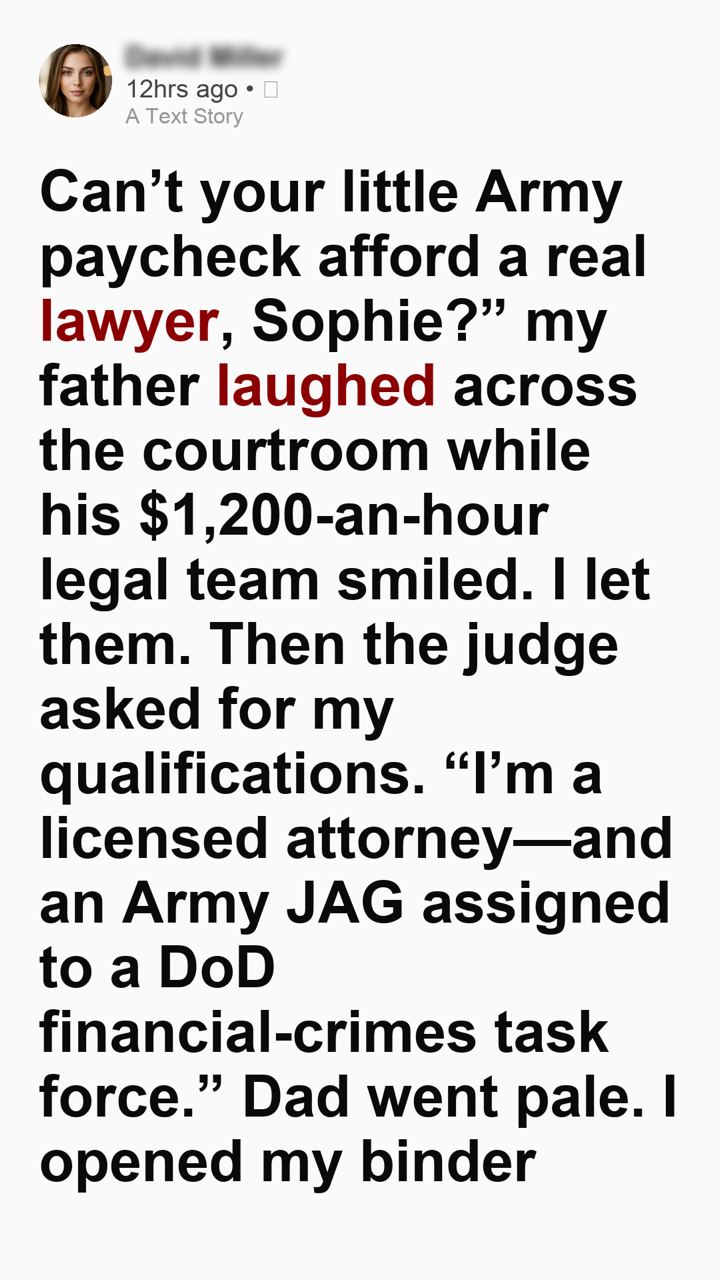
“Can’t your little Army paycheck afford a real lawyer, Sophie?”
My father said it loudly enough for everyone in Courtroom 4B to hear.
His four attorneys smiled.
I didn’t.
I simply rested my hand on the black binder in front of me.
My father leaned back in his chair.
He looked completely confident.
He had always been good at that.
My father owned a construction and defense-contracting company worth millions.
He drove cars I couldn’t pronounce.
He hosted charity dinners.
He knew judges, politicians, executives, and people who liked to remind everyone how important they were.
I had chosen a different life.
I joined the Army.
Then I went to law school.
Then I became a JAG officer.
My father called it my “little military adventure.”
He never understood why I didn’t care about his approval anymore.
That morning, he thought he was about to destroy me.
The lawsuit involved a family investment company.
My father claimed I had secretly withdrawn $780,000 and transferred it into an account I controlled.
He had bank statements.
Emails.
Wire-transfer confirmations.
Even a document carrying what appeared to be my signature.
His attorneys had built an impressive case.
Mine was simpler.
I was representing myself.
The judge entered.
Everyone stood.
“Be seated.”
My father’s lead attorney began.
“Your Honor, this is fundamentally a matter of financial misconduct.”
He presented the documents.
I listened.
My father watched me.
Every few minutes, he’d smile.
He wanted me nervous.
He wanted me humiliated.
Then his attorney said:
“The defendant has offered no credible explanation for these transfers.”
I stood.
“May I respond, Your Honor?”
The judge nodded.
“Briefly.”
I walked toward the evidence table.
“Those transfers weren’t made by me.”
His attorney smiled.
“Then who made them?”
I looked at my father.
“That is what I’m here to show.”
My father laughed.
“Show them, Sophie.”
I returned to my seat.
His attorney continued.
Then the judge looked at me.
“Ms. Carter, do you have counsel?”
“No, Your Honor.”
“Are you representing yourself?”
“Yes.”
The judge looked at my binder.
“Are you qualified to do so?”
My father smirked.
I stood.
“Yes, Your Honor.”
“What are your qualifications?”
I answered calmly.
“I’m a licensed attorney.”
The smile disappeared from my father’s face.
I continued.
“And I’m an Army JAG officer assigned to a Department of Defense financial-crimes task force.”
Silence.
One of my father’s attorneys stopped writing.
Another looked at me.
My father leaned forward.
“What?”
The judge raised an eyebrow.
“You’re military counsel?”
“Yes, Your Honor.”
“And you’re licensed to practice law?”
“Yes.”
The judge nodded.
“Proceed.”
I opened my binder.
The first page was a bank statement.
I placed it on the evidence table.
“Your Honor, my father claims I transferred $780,000.”
“Yes.”
“The account number listed here doesn’t belong to me.”
My father’s attorney immediately stood.
“That is impossible.”
I looked at him.
“It’s not.”
I turned the page.
“This account was opened eight months before the alleged transfer.”
The attorney frowned.
“And?”
“The account was opened using an identification document that contains my name.”
My father looked confused.
“Then it belongs to her.”
“No.”
I placed another document down.
“The identification number doesn’t belong to me.”
The judge leaned forward.
“What does it belong to?”
I looked at my father.
“His former executive assistant.”
The courtroom became quiet.
My father’s face changed.
I opened another section.
“The email account used to authorize the transfers was supposedly mine.”
I placed a printed forensic report down.
“But the login records show the account was accessed from a computer located inside my father’s private office.”
My father shook his head.
“This is nonsense.”
I looked at him.
“You told the court you had never accessed that account.”
“I haven’t.”
I turned to the judge.
“Your Honor, I’d like to submit the computer-forensics report.”
The judge accepted it.
My father’s attorney approached the bench.
They whispered.
Then he returned.
“Your Honor, even if there are irregularities, that doesn’t establish who made the transfers.”
I smiled.
“Correct.”
I opened the binder again.
“That is why I brought this.”
I placed a spreadsheet on the table.
It showed twenty-seven transfers.
Dates.
Amounts.
Receiving accounts.
Final destinations.
The judge studied it.
“Where did this come from?”
“Federal financial records.”
My father stiffened.
His attorney turned toward him.
My father whispered:
“I don’t know what she’s talking about.”
I continued.
“The $780,000 wasn’t stolen from the family company.”
I paused.
“It was part of a much larger movement of money.”
My father’s attorney objected.
“Your Honor, this is beyond the scope of the case.”
The judge looked at me.
“Explain its relevance.”
I nodded.
“The money used to create the false trail toward me originated from accounts connected to my father’s company.”
My father stood.
“That is an accusation.”
The judge looked at him.
“Sit down, Mr. Carter.”
He sat.
I opened another tab.
“Here’s the first shell company.”
I displayed the registration.
“It’s owned by an individual who has never worked for my father’s company.”
Next page.
“But this individual’s wife owns a consulting company.”
Next page.
“That consulting company received $2.3 million from my father’s company over three years.”
Next page.
“Those payments were listed as consulting fees.”
The judge asked:
“Were services actually provided?”
“No.”
“How do you know?”
“Because the company had no employees, no office, and no documented clients other than my father’s company.”
My father’s lead attorney stood again.
“Your Honor—”
The judge interrupted.
“Counsel, I’m listening.”
I continued.
“The money then moved through three additional companies.”
I placed another page down.
“Eventually, it reached an offshore account.”
My father was no longer looking at me.
He was staring at the table.
I knew then that he understood.
He finally realized what was inside my binder.
Not just evidence for a family lawsuit.
A map.
A map of money.
And I had spent eighteen months following it.
My father had been under federal scrutiny long before he filed the lawsuit against me.
He just didn’t know that I was part of the team reviewing the financial patterns.
I couldn’t investigate my own father directly.
That would have been a conflict.
But I could recognize the evidence when it crossed my desk.
And when he tried to frame me, he unknowingly connected the entire trail.
I turned another page.
“Your Honor, this is an internal company email.”
The judge read it.
My father’s attorney looked at him.
My father looked terrified.
The email instructed an employee to “make the Carter transfer look personal.”
The employee who wrote it was my father’s chief financial officer.
The judge looked at my father.
“Did you authorize this?”
“No.”
I placed another document down.
“Then you may want to explain why the email was sent from your account.”
My father stared at me.
“You’ve been investigating me?”
“No.”
I closed the binder.
“I’ve been investigating the evidence.”
The judge ordered an immediate forensic audit of the company’s finances.
The lawsuit against me was suspended.
The court referred the financial evidence to federal authorities.
Within weeks, the truth came out.
My father hadn’t just tried to frame me.
He had been diverting money through shell companies for years.
The amount wasn’t $780,000.
It was more than $11 million.
The lawsuit against me had been an attempt to create a false explanation for one portion of the missing money.
He wanted investigators to believe his daughter had stolen it.
His own daughter.
The person he thought was too insignificant to fight back.
The person he mocked for wearing a military uniform.
When the federal charges were eventually announced, my father lost nearly everything.
His company collapsed.
His accounts were frozen.
His business partners abandoned him.
And the family members who had once laughed with him stopped answering his calls.
A few months later, I received a letter.
It was from my father.
I almost threw it away.
Instead, I opened it.
There were only six lines.
Sophie,
I spent my whole life thinking money made me powerful.
Then you walked into that courtroom with one binder and proved me wrong.
I’m sorry.
Dad.
I read it twice.
Then put it away.
I didn’t hate him.
But I didn’t excuse him either.
Some things cannot be repaired by an apology.
Years later, I still remember Courtroom 4B.
I remember the laughter.
I remember my father’s $1,200-an-hour attorneys.
I remember him looking at my uniform and thinking it made me less important.
And I remember the judge asking:
“What are your qualifications?”
I could have told him about my education.
My military service.
My legal career.
My assignments.
My achievements.
Instead, I simply told the truth.
“I’m a licensed attorney—and an Army JAG officer.”
Then I opened my binder.
My father thought the binder contained my defense.
He was wrong.
It contained the beginning of his undoing.
And the most satisfying part wasn’t watching him lose his money.
It wasn’t watching his lawyers stop smiling.
It wasn’t even watching the judge order the investigation.
It was the moment my father finally understood something he should have known years earlier:
He had spent his entire life underestimating the wrong daughter.