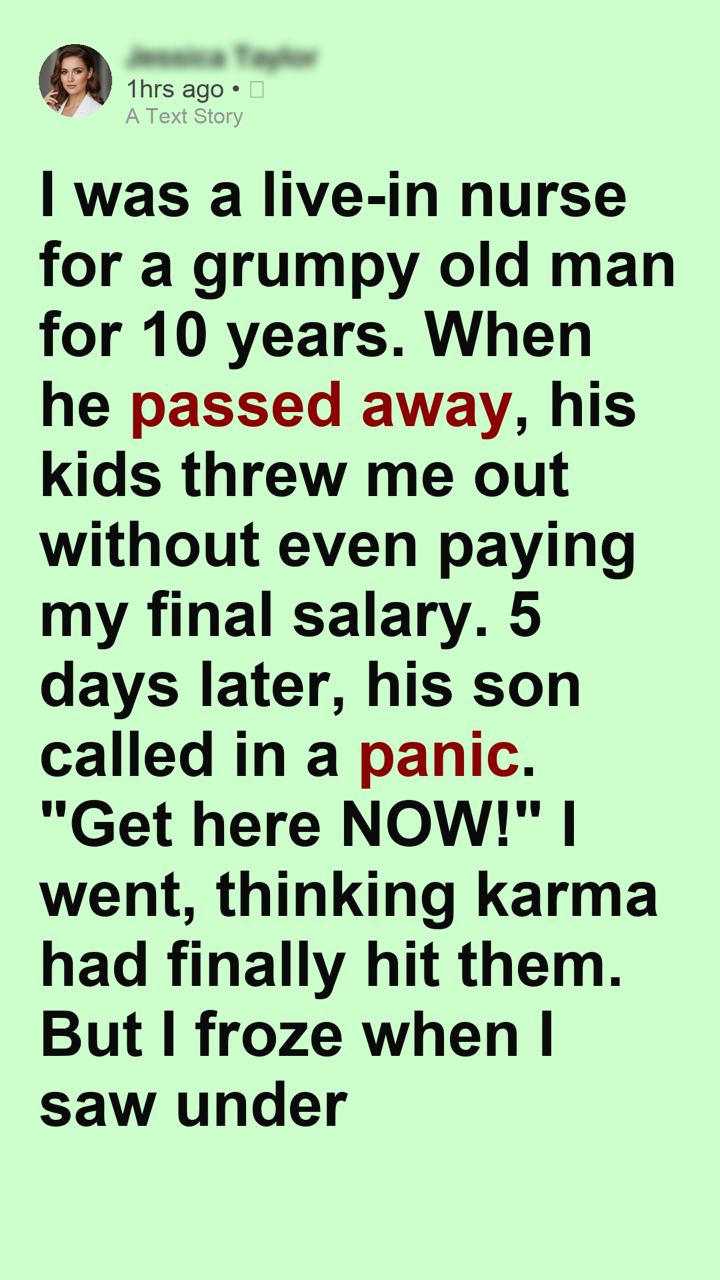
I was a live-in nurse for ten years.
Ten years of waking up before sunrise.
Ten years of measuring blood pressure, organizing medication, preparing meals, changing sheets, listening to the same stories over and over again.
And ten years of taking care of a man everyone else called difficult.
His name was Harold Whitmore.
He was eighty-six when he died.
His children called him stubborn.
His neighbors called him rude.
The nurses before me called him impossible.
I called him lonely.
Harold had been a successful businessman.
He had built a manufacturing company from nothing and spent most of his life believing that depending on people was a weakness.
After his wife died, he became even more difficult.
He refused assisted living.
He refused nursing homes.
And he refused every caregiver his children hired.
Then I arrived.
My name is Maria.
I was forty-nine when I started working for Harold.
I expected to stay six months.
I stayed ten years.
I was there when he fell in the bathroom.
I was there when he had pneumonia.
I was there when he forgot where he was.
I was there when he cried for his wife in the middle of the night.
And I was there when he took his final breath.
I held his hand.
He looked at me.
“Maria?”
“Yes?”
“Don’t let them…”
His voice faded.
“Don’t let them what?”
He never finished.
Those were his last words.
I thought his children would at least give me time to grieve.
I was wrong.
Three hours after the funeral home left, his oldest son, Richard, walked into the house.
“Pack your things.”
I stared at him.
“What?”
“You can’t stay here.”
“I know. I just need a little time.”
“No.”
His sister, Amanda, stood behind him.
“We have a realtor coming tomorrow.”
I couldn’t believe what I was hearing.
“I’ve worked here for ten years.”
“And Dad is gone.”
Amanda said it coldly.
“So your job is over.”
I swallowed.
“What about my final salary?”
Richard looked annoyed.
“We’ll deal with that later.”
“You owe me for three weeks.”
“I said we’ll deal with it.”
They gave me two hours to pack.
Two hours.
Ten years of my life reduced to two suitcases.
I stood on the front porch that evening holding my belongings.
Richard closed the door behind me.
No goodbye.
No thank you.
Not even a handshake.
I sat in my car and cried.
Not because I had lost my job.
Because I had lost the man I had spent ten years protecting.
I drove to my sister’s apartment.
I expected to hear from the Whitmores about my salary.
I didn’t.
One day passed.
Two.
Three.
Nothing.
Four.
Still nothing.
On the fifth morning, my phone rang.
It was Richard.
I almost didn’t answer.
“Hello?”
“Maria?”
His voice sounded strange.
“Richard?”
“Where are you?”
“At my sister’s.”
“You need to come back here.”
I laughed bitterly.
“Why?”
“Please.”
“What happened?”
“I can’t explain over the phone.”
“Then don’t.”
There was silence.
Then he whispered:
“Dad left something for you.”
My heart stopped.
“What?”
“Just get here.”
“Why?”
“Because we found it.”
“What did you find?”
His voice cracked.
“Something under the floor.”
I drove back immediately.
When I arrived, Richard was waiting outside.
He looked terrified.
“What happened?”
He didn’t answer.
He simply opened the door.
The house looked completely different.
Furniture had been moved.
Drawers were open.
Boxes were everywhere.
Amanda stood in the hallway.
She was crying.
I had never seen her cry before.
“What is going on?”
Richard pointed toward Harold’s study.
“Come inside.”
I followed him.
The large wooden desk had been pushed aside.
The carpet was rolled back.
And there, beneath a loose floorboard, was a small metal door.
I froze.
“What is that?”
Richard shook his head.
“We don’t know.”
He opened it.
Inside was a steel box.
He lifted it carefully.
There was a combination lock.
Amanda whispered:
“We tried every number we could think of.”
Richard looked at me.
“Then I remembered something.”
“What?”
“Dad’s last words.”
Don’t let them…
He paused.
“You were the last person he spoke to.”
I stared at the box.
“What does that have to do with me?”
Richard handed me a piece of paper.
On it was a single sentence.
Maria knows the combination.
I felt the room spin.
“I don’t know anything about this.”
“Think.”
I stared at the numbers.
Then I remembered.
Ten years earlier, Harold had asked me to help him organize his personal documents.
He had told me:
“If I ever forget something important, remember the date my wife died.”
I had written the date in my notebook.
I tried it.
Click.
The lock opened.
Everyone went silent.
Inside were documents.
Bank statements.
Property deeds.
Company records.
Photographs.
And an envelope with my name on it.
My hands trembled as I opened it.
Maria,
If you are reading this, then I’m gone.
I stopped.
Harold’s handwriting.
I could almost hear his voice.
My children will probably tell you that you were only my employee. They will probably say I owed you nothing beyond your salary.
My eyes filled with tears.
They are wrong.
I continued.
For ten years, you gave me something my money could never buy. You gave me dignity. You stayed when everyone else left.
I covered my mouth.
Richard looked away.
Amanda started crying.
The letter continued.
I know what my children have done behind my back.
I looked at Richard.
He went pale.
I know about the money they took from the company.
Silence.
Richard whispered:
“No…”
I kept reading.
I know about the accounts they created. I know about the properties they transferred. And I know they believe my illness made me too confused to notice.
I looked at Amanda.
She was trembling.
The next paragraph changed everything.
I allowed them to believe that.
Harold had known.
For years.
He had secretly hired an investigator.
He had documented every transaction.
Every unauthorized transfer.
Every forged signature.
Every missing dollar.
The box contained enough evidence to destroy them.
But that wasn’t the biggest surprise.
At the bottom of the box was another document.
A property deed.
I read the address.
It was Harold’s house.
The house I had lived in for ten years.
The deed had been transferred six months earlier.
To me.
I couldn’t speak.
Richard stared at the paper.
“That’s impossible.”
Amanda shook her head.
“Dad couldn’t have done that.”
I looked at the date.
He had.
The house was legally mine.
But there was more.
Another document showed that Harold had created a trust.
The beneficiary was me.
Inside the trust were investments worth more than $2 million.
My knees weakened.
“Why?”
Richard finally spoke.
“Because he knew what would happen.”
I looked at him.
“What?”
He lowered his head.
“He knew we’d throw you out.”
I stared at him.
Harold had anticipated everything.
He knew his children would treat me like an employee.
He knew they would refuse to pay me.
He knew they would sell the house.
And he knew they would eventually discover the box.
The final page of the letter said:
Maria, you spent ten years caring for me. Now I want you to spend the next ten years caring for yourself.
I began to cry.
Not because of the money.
Because Harold had understood something nobody else had.
I had spent my entire life taking care of other people.
He wanted me to finally take care of myself.
Richard sat down.
“Maria…”
I looked at him.
“I am sorry.”
I said nothing.
“I was horrible to you.”
“Yes.”
“I thought Dad was leaving you nothing.”
“You didn’t even ask.”
“I know.”
Amanda stepped forward.
“Can you forgive us?”
I looked at both of them.
“I can forgive you.”
They looked relieved.
“But I won’t forget.”
Richard nodded.
“That’s fair.”
Then I did something neither of them expected.
I handed them copies of the evidence.
Richard stared at them.
“What are you doing?”
“You’re going to make things right.”
“With what?”
“Everything you took.”
He looked terrified.
“And if we don’t?”
I smiled.
“Then the lawyers will handle it.”
For the first time, I saw fear in his eyes.
Not fear of losing money.
Fear of facing the truth.
The investigation eventually uncovered nearly $3 million in fraudulent transfers.
Richard and Amanda had to return most of the money.
The company survived.
The house became mine.
And I finally received every dollar of the salary they had withheld.
But I didn’t stay in Harold’s house.
I sold it.
Then I used part of the money to open a small assisted-living residence.
Not a cold institution.
A real home.
A place where elderly people could live with dignity.
I named it Harold House.
On the front wall, I placed a simple plaque:
For the people who spent their lives caring for everyone else.
Years later, Richard came to visit.
He brought flowers.
“I wish Dad could see this,” he said.
I smiled.
“He can.”
Richard looked at me.
“How?”
I touched the plaque.
“He knew exactly what I would do.”
He smiled sadly.
“You were the only person who ever understood him.”
I shook my head.
“No.”
“I think he was the first person who understood me.”
Richard nodded.
Then he left.
I stood in the doorway watching him disappear.
Five days after Harold’s funeral, his son had called me in panic.
He thought he was calling me back because his father had left something behind.
He was right.
Harold had left something behind.
Not just money.
Not just a house.
Not even justice.
He had left me something far more valuable.
He had left me permission to stop living as someone’s employee…
and start living as my own person.
And every night at Harold House, when I walk through the quiet halls and hear the residents laughing together, I think about the grumpy old man who once told me that needing people was weakness.
Near the end of his life, he finally changed his mind.
Because he learned something.
So did I.
Sometimes the person who seems the hardest to love…
is simply the person who has been waiting the longest for someone to stay.