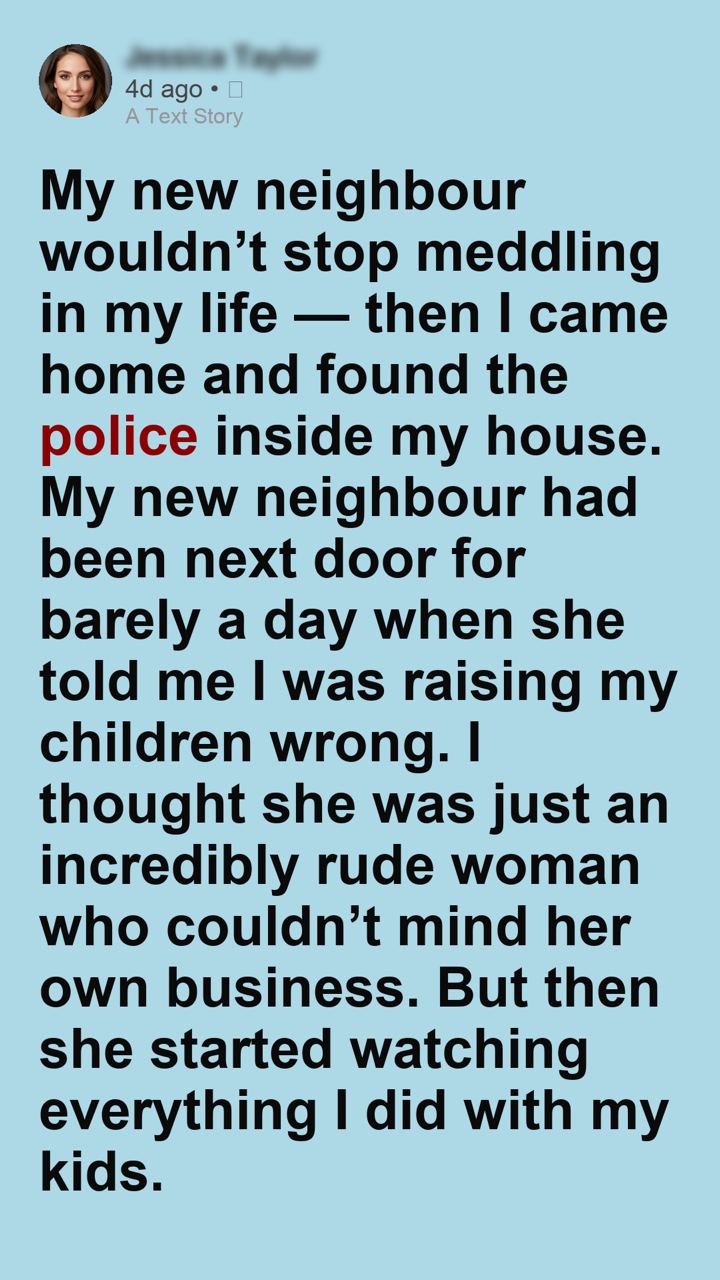
My new neighbours had been living next door for less than twenty-four hours when she told me I was raising my children wrong.
I was standing on my porch, carrying two grocery bags while my eight-year-old son, Noah, struggled with the front door.
My six-year-old daughter, Lily, was sitting on the steps eating an apple.
The woman next door watched us from behind her curtains.
Then she opened her door.
“You shouldn’t let them eat outside.”
I looked at her.
“Excuse me?”
She pointed at Lily.
“She’s going to make a mess.”
Lily immediately stopped chewing.
I smiled politely.
“She’s fine.”
The woman frowned.
“Children need structure.”
I nodded.
“Thank you for your opinion.”
I went inside.
I assumed that would be the end of it.
It wasn’t.
Her name was Margaret.
She was in her late fifties, always perfectly dressed, always watching.
The next morning, I was walking Noah to the bus stop.
Margaret stood in her driveway.
“Your son needs a jacket.”
I looked at Noah.
He was wearing one.
“He has one.”
“It’s too thin.”
“He’s fine.”
She shook her head.
“You young mothers don’t understand.”
I ignored her.
The following day, she complained that Lily was playing in the yard after six.
Then she complained that Noah rode his bicycle too close to her driveway.
Then she asked why I didn’t have a fence between our properties.
Then she told me my children were “too loud.”
Every day, another complaint.
I tried being polite.
Then firm.
Then I stopped responding.
But Margaret didn’t stop watching.
She sat on her porch for hours.
She watched when my children left for school.
She watched when they came home.
She watched who visited.
She watched when I went to work.
It became creepy.
One afternoon, I caught her standing near my mailbox.
“What are you doing?”
She turned.
“Checking something.”
“Please don’t touch my mail.”
She smiled.
“I was only looking.”
I stared at her.
“Stay away from my property.”
Her smile disappeared.
“You’re making a mistake.”
“What does that mean?”
“You’ll understand.”
She walked away.
I thought she was simply a strange, controlling woman.
I was wrong.
Three days later, I came home from work and immediately knew something was wrong.
My front door was open.
My heart stopped.
I dropped my purse.
“Noah?”
No answer.
“Lily?”
Silence.
I ran inside.
Then I saw them.
Three police officers were standing in my living room.
One officer turned toward me.
“Ma’am, please stay where you are.”
My hands began shaking.
“Where are my children?”
“They’re safe.”
“Where?”
“Your mother picked them up from school.”
I almost collapsed.
“What happened?”
The officer looked at me.
“We received a report about your children.”
“What kind of report?”
He hesitated.
“Neglect.”
I stared at him.
“What?”
“We received allegations that your children were being left home alone.”
“That is a lie.”
The officer nodded.
“We’re aware there may be inaccuracies.”
“Who called you?”
He looked toward the window.
“Your neighbor.”
My stomach dropped.
“Margaret?”
“Yes.”
I felt furious.
“She has been harassing me for days.”
The officer lowered his voice.
“She also provided photographs.”
“What photographs?”
He handed me a folder.
Inside were pictures of my children.
Walking to school.
Playing outside.
Eating dinner.
Getting into my car.
I stared at them.
“She was spying on us.”
“Yes.”
“There are dozens.”
The officer nodded.
“We’re investigating.”
Then he said something that confused me.
“There’s one more thing.”
“What?”
“We found a hidden camera.”
My blood ran cold.
“Where?”
“Inside your house.”
I couldn’t breathe.
The officer pointed toward the hallway.
“Behind the smoke detector.”
I stared at it.
That smoke detector had been installed six months earlier.
By a contractor.
Someone had entered my house.
Someone had been watching my family.
And Margaret had moved in only days ago.
That evening, my mother came over.
The children were staying with her.
I sat on the couch staring at the camera.
“I don’t understand.”
Mom squeezed my hand.
“Maybe she really is just crazy.”
“No.”
I shook my head.
“She knew things nobody else knew.”
“Like what?”
I thought about it.
“She knew when Lily woke up crying last Tuesday.”
Mom’s face changed.
“How?”
“I don’t know.”
Then I remembered something.
“Wait.”
I stood.
I went to the garage.
There was a box of old paperwork.
I searched through it.
Then I found the document I was looking for.
The receipt from the contractor who installed our security system.
I read the company name.
Then I froze.
It was the same company Margaret had mentioned two days earlier.
I called the police.
An hour later, they arrived.
The contractor’s records showed something disturbing.
A technician had returned to my house two weeks earlier.
I hadn’t requested a visit.
Someone had used my name to authorize it.
The technician who came had installed the hidden camera.
But who hired him?
The police traced the payment.
It led to an account belonging to Margaret.
Everything suddenly made sense.
But there was still one question.
Why?
The next morning, the police searched Margaret’s house.
They found hundreds of photographs.
Not just of my children.
Photographs of previous families who had lived in the neighborhood.
There were folders.
Dates.
Schedules.
Names.
License plates.
Medical appointments.
School information.
It wasn’t random.
Margaret had been collecting information about people for years.
Then investigators found something else.
A notebook.
On the first page was a list of families.
Beside each name was a number.
My name was at the top.
Next to it:
“Priority.”
I felt sick.
The police arrested her.
But before they took her away, she asked to speak to me.
I almost refused.
Then I agreed.
She sat across from me in an interview room.
For the first time, she didn’t look confident.
She looked tired.
“Why?” I asked.
She stared at the table.
“You reminded me of my daughter.”
“What happened to her?”
Margaret swallowed.
“She had two children.”
I waited.
“She was a single mother.”
Her voice cracked.
“People judged her.”
“What does that have to do with me?”
“She struggled.”
Margaret looked at me.
“Everyone told her she was doing everything wrong.”
I slowly realized where this was going.
“Did she lose her children?”
Margaret nodded.
“They were taken away.”
“Why?”
“Because she trusted the wrong people.”
I felt a chill.
“And you thought you were protecting my children?”
“Yes.”
I stared at her.
“You broke into my house.”
“I needed to know if you were safe.”
“You installed a camera.”
“I needed proof.”
“You lied to the police.”
“I was trying to get them involved before something happened.”
I shook my head.
“You don’t protect children by destroying their parents’ lives.”
She looked down.
“I know that now.”
I stood.
“I hope you do.”
As I walked away, she called after me.
“Your children are lucky.”
I stopped.
“Why?”
“Because you fight for them.”
I didn’t answer.
I walked out.
Months later, Margaret was sentenced for the crimes she committed.
The hidden-camera investigation uncovered several other victims.
Families who had been watched.
Photographed.
Tracked.
Some had never even realized it.
As for me, I installed new locks.
New cameras.
And a tall fence around the backyard.
But something else changed.
I stopped worrying about whether my parenting looked perfect to other people.
Because it wasn’t perfect.
Sometimes I lost my patience.
Sometimes dinner was cereal.
Sometimes the children stayed up too late.
Sometimes I made mistakes.
But my children knew they were loved.
And that mattered more than Margaret’s judgment.
One evening, Lily was drawing with chalk on the driveway.
Noah was riding his bicycle.
I sat on the porch watching them.
Lily looked up.
“Mom?”
“Yes?”
“Are we allowed to be loud?”
I laughed.
“Yes.”
She smiled.
“Good.”
Then she went back to drawing.
I looked at the empty house next door.
The curtains were closed.
The porch was silent.
For the first time since Margaret arrived, I felt completely safe.
A year later, another family moved in.
A young couple with a little boy.
On their first day, the mother knocked on my door.
“Hi. We’re your new neighbors.”
I smiled.
“Welcome.”
She laughed nervously.
“Sorry if we’re noisy.”
I looked at her little boy.
He was holding a toy truck.
I smiled.
“Don’t apologize.”
She looked surprised.
“Children are supposed to be noisy.”
Her shoulders relaxed.
“Thank you.”
As she walked away, I realized something.
Margaret had spent years watching people because she believed fear was the same thing as protection.
She was wrong.
Protection isn’t surveillance.
It isn’t control.
It isn’t deciding that you know what’s best for everyone else.
Sometimes protection is simply standing beside someone…
and letting them know they aren’t alone.
I thought my new neighbor was merely a rude woman who couldn’t mind her own business.
I had no idea she was watching my family from the moment she arrived.
And when the police entered my house, I thought they had come to take my children away.
Instead, they uncovered something far more frightening.
My neighbor wasn’t just watching us.
She had been watching families for years.
And the strangest part?
She truly believed she was the hero of every story.
Until someone finally stopped her.